Barton Hollow – The Civil Wars
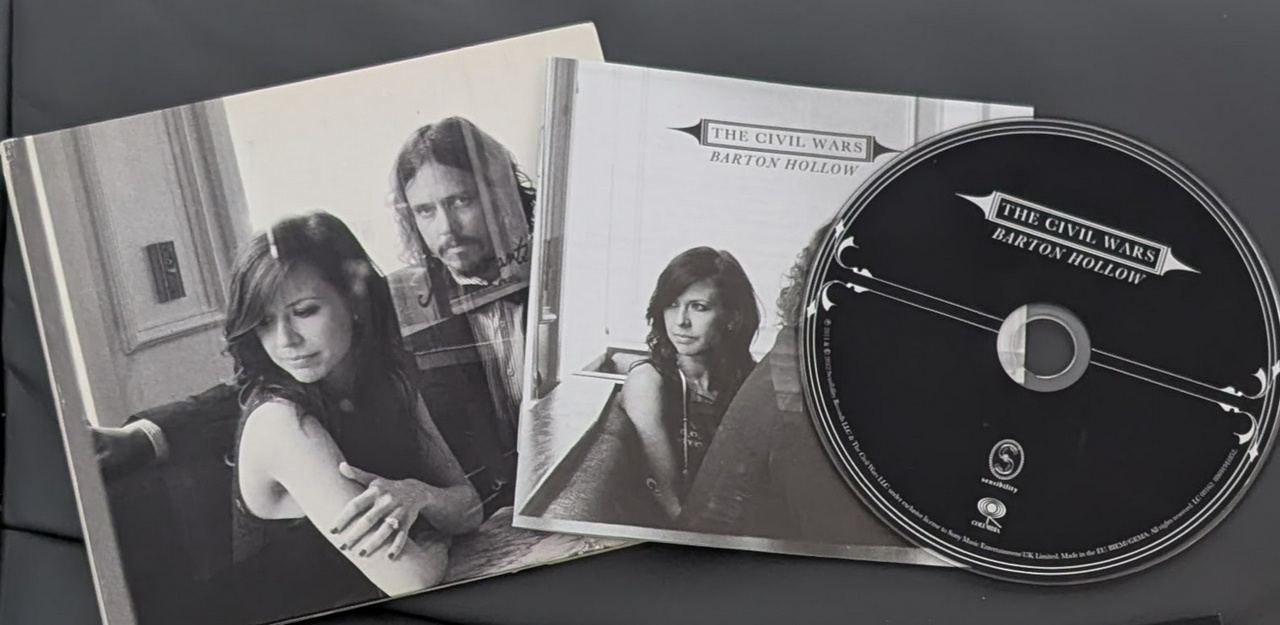
Short-lived as their career was, The Civil Wars produced some of the best Americana storytelling of their era: emotional, but devoid of unnecessary soppy sentimentality. No filler, no skips, just songs that all pull their weight.
I remember while living in the U.S. spending a lot of time exploring Americana. That exploration led me to Jason Isbell, and the Drive-By Truckers, Old Crow Medicine Show, Shovels & Rope, and others. But it was The Civil Wars that struck a particular chord with me (pun intended). The quality song writing partnered with honest reflection wrapped in layers of sparsity that just work.
Barton Hollow is the kind of record that rewards a slow relisten — not because it's demanding, but because it's so sparse that everything you missed the first ten times finally has room to land. By the 11th listen that sparsity has layers and carries an emotional weight that wasn’t immediately obvious
20 Years
The first track on the album, and also the first one I remember hearing. One of the things that has always struck about The Civil Wars is how their voices aren't just complimentary, but weave together through melody and harmony.
If I recall correctly, this song is about a family secret related to one of them — but that's all that's ever been shared, and the mystery is cloaked in the misty Southern vibe. There's definitely a sense that the secret is never resolved, and the listener is left to ponder. But that pondering isn't necessarily a negative — if anything, it adds to the song's weight. It's that sense of mystery that first encouraged me to seek out more of their catalogue.
I've Got This Friend
Simple, but wonderfully executed. This is the track that proves the album's depth beyond the singles — no key change, no vocal fireworks, just a well-observed lyric and a melody and simple story that trusts the listener to feel it rather than being told to.It’s also immediately relatable. I think that’s the power of the Civil Wars, they tell a story through music, melody, and lyric but don’t feel the need to spoonfeed you into an emotional response. The bridge in particular is a beautiful meander of their complimentary vocals.
C'est La Mort
Could easily picture R.E.M. doing a rendition of this song and retroactively sticking it on Automatic for the People. It’s exactly the right register — hushed, mortality-haunted, elegant rather than bombastic, a song written from inside grief rather than looking back at it, letting the melody carry the weight instead of the lyric spelling it out. Sitting with it longer, I can also hear Eddie Vedder singing this — it has hints of “Just Breathe,” that same stripped-back, plainspoken intimacy with mortality, unafraid of the subject rather than skirting around it.
To Whom It May Concern

If Cinderella was set on a Southern plantation, this would be the song that played when Cinderella and the Prince are reunited. Even a “happy” moment on this record doesn't get a big sweeping orchestral triumph — it gets something quiet and aching instead, joy delivered in the same hushed register as the grief elsewhere on the album.
Poison & Wine
A song about two people who find themselves in a failed or failing relationship. Their most famous song, but I found it the least interesting track on the record — a little flat, sonically uninteresting, as close to skippable as this album has. Maybe that's the irony of it: the same sparseness I've praised everywhere else on Barton Hollow works against this one for me. Here it reads as flatness rather than restraint — proof that “less is more” isn't automatically successful just because it's the band's signature move.
My Father's Father
Has that small West Virginia mining town bluegrass vibe — a different corner of “Southern” entirely to the plantation-Gothic tracks elsewhere on the record, harder and dustier, generational hardship baked into the sound rather than genteel decay. The title itself does a lot of the work: an inheritance passed down through generations of men in a hard place. It's someone who wants to leave someplace but is trapped by that inheritance.
Barton Hollow
The record's mission statement, and arguably still their best song. Built on almost nothing — a driving guitar figure, some percussive stomping, two voices — and yet it's the most menacing thing they ever recorded, closer to a murder ballad than a folk song. As an opener it sets a tone the rest of the album never has to fully match again. It's also the song that announces who they are, in a way most bands need two or three albums to manage.
As a murder ballad, it's worth contrasting with something like Colter Wall's “Kate McCannon” — a classic murder ballad in the fullest sense, narrating the whole crime plainly: courtship, betrayal, confession, motive and method all laid bare from the killer's own mouth. “Barton Hollow” works almost in reverse. There's violence and consequence in the air, but the actual who-did-what-to-whom is never spelled out — atmosphere and implication rather than narrative. Wall gives you the whole crime scene; The Civil Wars just give you the guilt hanging over one. Fitting, given the same instinct runs through “20 Years” — withhold rather than confess, and let the listener carry the unresolved weight.
The Violet Hour
A beautiful instrumental piece. Starts off somewhat sombre, but gradually feels more hopeful, yet the cello keeps that hope grounded. And in true Civil Wars style, it ends feeling like the future has not yet been written. Has very TV theme tune vibes — Twin Peaks meets The X-Files.
Girl with the Red Balloon
Pure Leonard Cohen, with a touch of Serge Gainsbourg. The opening image — a pub on the south side of town, where time stands still while there's still wine around — does a whole backstory's worth of work in one line, the way Cohen so often let a room describe a character rather than naming a feeling. The Gainsbourg comparison lands in the mood: warm, a little dangerous, sung with an intimacy that undercuts how sad the actual situation is. It's a good reminder they weren't purely an Americana act — there's a genuine chanson tradition running under the surface too.
Falling
A swirling number. Where “Barton Hollow” is percussive and driving, “Falling” is disorientation set to music — a circular, almost hypnotic guitar figure and vocals that overlap rather than trade cleanly. The lyrics flow through the melody rather than sitting in tidy rhythmic boxes, stretching and compressing to match the emotional shape of the line — the same instinct you hear in Cohen or Joni Mitchell, where the tune sounds discovered rather than imposed. Even singing the “same” line, Williams and White sometimes land a syllable apart, which only adds to the vertigo.
Forget Me Not
Appalachia sweeps into Georgia's peach orchard and on to the porch of a Savannah plantation — a whole regional journey carried entirely in pacing and hush, without a single line of exposition. This is the album's Southern Gothic instinct at its purest: no magnolias, no sweet tea, nothing so on-the-nose. Just the sense of something old sitting on that porch, and a melody quiet enough to let it breathe.

Birds of a Feather
Another triumph of their vocals intertwining. The call-and-response to begin, before blending together. It's arguably the perfect metaphor for their pairing as artists — fitting, in hindsight.
Bonus Tracks
Billie Jean / I Want You Back
Their takes on these two are unique. Both flip their originals almost completely — Michael Jackson's “Billie Jean” is one of the most instantly recognizable grooves in pop music, all paranoid propulsion and dance-floor tension, but The Civil Wars strip that away entirely for a fingerpicked, swing-feel acoustic arrangement that turns a song about denial into something closer to a confession whispered across a table. “I Want You Back” is an even bigger swing — the original is pure euphoric Motown joy, so finding the yearning underneath the celebration is a much harder trick than slowing down a song that was already melancholy to begin with.
Dance Me to the End of Love
One of the rare moments where I enjoy a cover more than the original. Leonard Cohen's version is already iconic and kind of untouchable — dry, world-weary, with a sinister waltz undertow. The Civil Wars seem built for exactly this kind of material: restraint, close harmony, nowhere to hide. They're not trying to out-perform Cohen, they're finding the quieter, sadder song that was arguably always inside it.
You Are My Sunshine
This one immediately reminded me of my mother — she used to sing the chorus to us when we were young, to cheer us up when we were upset, and if it wasn’t this song it was Two Little Boys, which was a hit in its own right for the infamous Rolf Harris. It's a song that's been passed down so informally, parent to child, generation to generation, that most people who know it learned it the same way I did: sung to them, not from a record.
Fitting that The Civil Wars would be the ones to cover it too, given how much of their own catalogue plays with the contrast between a comforting surface and something more aching underneath.
Goodbye Girl
Not a cover, as it turns out — an original, despite the title's borrowed familiarity. Built around a small, precise image: someone forgetting their grandmother's scarf as they walk away in the park. Same songwriting DNA as the rest of the record — one specific, unremarkable object doing all the emotional work instead of a big declarative line about heartbreak.
The Theme Running Underneath It All
If there's a thread tying Barton Hollow together, it's this: love here is beautiful and hard — often a burden, something to be endured, sometimes naive, sometimes complicit, even compliant. The record rarely lets love be just one thing.
“Poison & Wine” is love as compulsion, damage and devotion inseparable. “Girl with the Red Balloon” is love as accommodation — someone permanently cast as the one who lets others in without ever quite being let in herself. Even “Barton Hollow” itself, on the surface a stomping outlaw song, carries that same undercurrent of consequence and reckoning running through nearly every love song on the record.
What keeps it from tipping into melodrama is that nobody in these songs is purely wronged. The narrator is usually implicated in their own undoing — staying too long, loving the wrong way, complicit in the same poison they're naming. That's love as something people participate in even while it costs them, which is a harder and more honest thing to write than straightforward heartbreak.